

Digitised Manuscripts and Early Printed Books
Books were of great importance in the Middle Ages. They were repositories of the knowledge of the time. Through them, the body of knowledge from antiquity was preserved. In many cases, things such as philosophical, medical or astronomical writings were initially recorded in Arabic translations and were later translated into Latin.
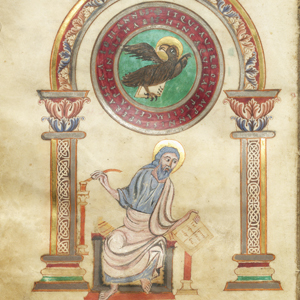
Books were central to Christianity, as the religion was based on the Bible. New manuscripts were constantly being produced to disseminate and explain the Bible, and different books were needed for church services, prayers, and hymns.
Before the invention of printing in the mid-15th century, books were made by hand and reproduced by copying. Depending on their intended use and client, they were magnificently designed with writing and paintings. Mainly produced in monasteries by men and women, manuscript production slowly shifted to commercial workshops from the beginning of the 13th century.

The Museum Schnütgen holds a modest collection of manuscripts from the late 9th to the early 16th century, as well as printed books from before and after 1500 (incunabula and early printed books). These include a precious gospel book from the late Carolingian period (before 880), a copy of Schedel's famous world chronicle (printed in 1494), and a printed book of hours produced in 1525 by a printing and publishing house run by a woman.
Thanks to cooperation with the Archdiocesan and Cathedral Library of Cologne, it is possible to make the holdings accessible step by step.

The link below takes you to digitized works; first to a home page where you can choose between manuscripts and printed books, and from there to the individual works with brief descriptions and the option to browse through the manuscript or printed book:
Digital collection of manuscripts and printed books from the Museum Schnütgen
