
Bronze sculpture
Bronze, a metal alloy created by blending copper and tin over fire, symbolises constancy, glory and honour and was therefore the material of choice for instruments used for divine services such as candleholders, censers or pouring vessels. In the Middle Ages, the most commonly used bronze casting process was lost-wax casting. In this process, a wax model is coated with a heat-resistant material. When heated, the wax melts out of the mould, leaving it hollow. Liquid bronze is then poured into the mould.
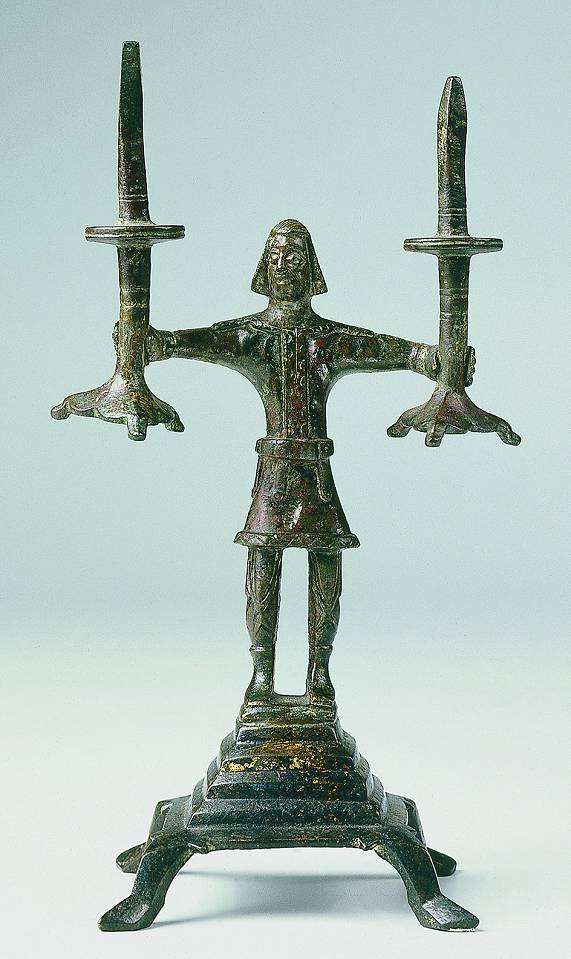
Male Figure as Candleholder (Acolyte),
Byzantine Empire, 6th cent., cast bronze, h. 23.5 cm, inv. no. H 851, © Rheinisches Bildarchiv


Crucifix of a Processional Cross, Rainer von Huy (?), Liège, c. 1110/1120, bronze (yellow brass), 16 x 17 cm, Inv. No. H 70, © Rheinisches Bildarchiv

Container in the Form of a Church Model, Lower Rhine (Cologne?), 11th/12th cent., bronze, 5.3 x 10.1 cm, inv. no. H 43, © Rheinisches Bildarchiv

Lion’s Head Door Pull, Magdeburg (?), c. 1150, cast bronze, Ø 23 cm, inv. no. H 20, © Rheinisches Bildarchiv

